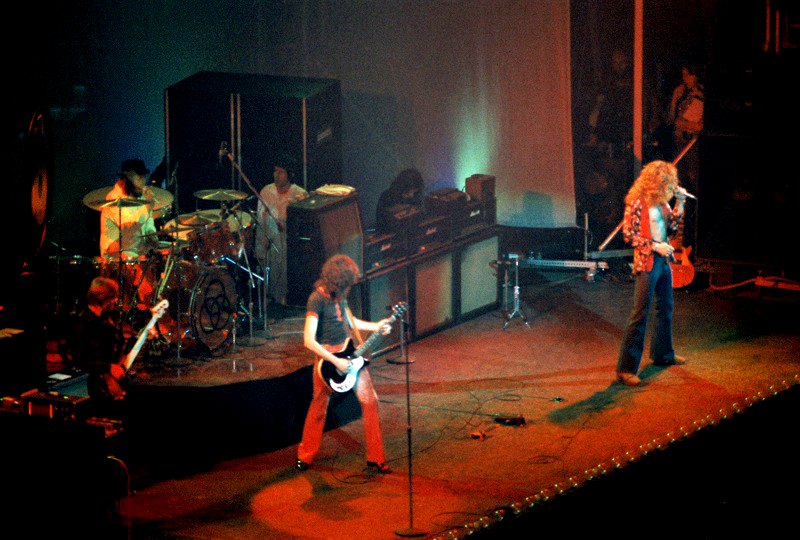
Led Zeppelin at Chicago Stadium, January 1975
Led Zeppelin · 1968–1980

The case for the heaviest complete band

Robert Plant, Jimmy Page, John Paul Jones, John Bonham. Eight studio albums. Eight British number-one albums in a row. The Rock and Roll Hall of Fame's own biography says they were as influential in the 1970s as the Beatles were in the 1960s. That sentence is the entire Zeppelin brief, waiting to be proven.

The opening statement

If the trial is decided by who sold more singles to more living rooms, Zeppelin lose before the needle drops. They refused that game. They built albums, then built rooms large enough to hold them, then played those rooms until the riffs became climate.

The Beatles wrote the wider language. Zeppelin wrote the one that every hard-rock and metal band still speaks. Four virtuosos, almost no filler, and a live reputation the Beatles abandoned in 1966.

Hamburg, 1973. Four players, one weather system. CC BY-SA 2.0.

1968–1980

Robert Plant

Voice, harmonica, lyric myth

The hard-rock vocal template — and later, its most skeptical alumnus.

1968–1980

Jimmy Page

Guitar, production, the map

Session ace turned architect. Alternate tunings, bow, and the riff library.

1968–1980

John Paul Jones

Bass, keys, arrangements

The quiet virtuoso. Without Jones, Zeppelin is a power trio with better lighting.

1968–1980

John Bonham

Drums, weight, swing

Died 1980; the band ended. The most imitated rock drummer who still cannot be copied.

Five arguments, with exhibits

Exhibit 01

Four virtuosos, one organism

If the question is 'who could actually play,' the argument ends quickly. Page, Plant, Jones, and Bonham are a closed ecosystem of peak rock technique.

  • Page: session veteran, alternate tunings, bow, production. Jones: bass, keys, arranging, the secret composer. Bonham: the most cited rock drummer. Plant: the template for hard-rock vocals.
  • Page: 'always four musicians at the top of their game, but they could play like a band.'
  • Plant on Achilles / Levee: the credits belonged to what 'those three guys were doing in the studio.'
  • Odd-meter Black Dog, the Levee stairwell drum sound, Jones's eight-string Alembic lines — none of this is amateur brilliance. It is craft.

Concession: The Beatles were better ensemble singers and more inventive writers. Virtuosity is not the only musicianship.

Exhibit 02

They were a live band. The Beatles stopped.

After 1966 the Beatles were a studio project. Zeppelin built the modern stadium show and then filled it for a decade.

  • Tampa Stadium, 5 May 1973: often cited 56,800 — among the largest paid rock crowds of the era.
  • Pontiac Silverdome, 1977: 76,229 reported.
  • Shows regularly stretched past three hours; Dazed and Confused could eat a Beatles set length by itself.
  • The 2007 O2 reunion (Celebration Day) is still treated as a late-period proof of concept — the machine still ran.

Concession: Beatles tours invented stadium pop (Shea) and then walked away because the screaming made music impossible. That is a different kind of courage.

Exhibit 03

They won the album era on purpose

Zeppelin treated the album as the artwork and refused the singles economy that made the Beatles. That was a philosophy, not a failure.

  • No British singles in the classic years. Stairway to Heaven was not released as an American single in the 1970s and still became radio's mountain.
  • Five American ten-million albums from a short catalogue — one of the highest conversion rates of any act.
  • Led Zeppelin's untitled fourth album: about 37 million worldwide, twenty-four times platinum in the United States — a single-album peak the Beatles' individual studio albums do not match.
  • Eight consecutive British number-one albums.

Concession: Refusing singles also hid them from the American singles scoreboard this site still reports. You cannot win a game you declined to play — and you cannot be blamed for declining it.

Exhibit 04

They invented a climate

Hard rock, heavy metal, stadium rock, and a huge slice of 1990s alternative all walk through a door Zeppelin kicked open.

  • Rock Hall: as influential in the 1970s as the Beatles were in the 1960s.
  • Deep Purple, Black Sabbath's heavier cousins, Van Halen, Guns N' Roses, Soundgarden, Pearl Jam, and countless riff bands cite the template.
  • The quiet-loud architecture of Stairway and the world-drone of Kashmir became genres.
  • Rolling Stone's long-running epithets: heaviest band, biggest band of the seventies, among the most enduring.

Concession: Zeppelin themselves walked through doors the Beatles, the Yardbirds, Chicago blues, and British folk had already opened. Influence is a relay.

Exhibit 05

Almost no filler, almost no committee

Eight studio albums. Four people. No fifth-member politics, no movie-contract filler, very little 'will this be a single.' The hit rate is brutal.

  • From I through Physical Graffiti the floor is extraordinarily high; even Presence, written around injury, has Achilles Last Stand.
  • Physical Graffiti's leftovers still play like A-sides.
  • They were also one of the most bootlegged bands in rock — a perverse metric of how badly people wanted more than the official eight.
  • Kennedy Center Honors (2012) and Polar Music Prize (2006) treat that slim catalogue as a complete language.

Concession: A short catalogue can also mean a narrower emotional range. The Beatles' 'filler' is other people's favourite song.

A compressed timeline

  1. 1968

    Page forms the New Yardbirds

    Plant, Jones, and Bonham join. The name becomes Led Zeppelin.

  2. 1969

    Abbey Road meets Led Zeppelin I & II

    The only year both classic catalogues are fully alive. Two different futures of rock, same calendar.

  3. 1971

    Untitled fourth album

    Stairway, Black Dog, When the Levee Breaks. The hard-rock canon condenses onto one album.

  4. 1973–75

    Houses, stadiums, Physical Graffiti

    Tampa-scale crowds. Kashmir. The biggest band of the decade.

  5. 1979–80

    Knebworth, then Bonham

    In Through the Out Door. John Bonham dies in September 1980. The band closes.

  6. 1988 / 1995

    Hall of Fame

    Beatles inducted first year eligible (1988). Zeppelin in 1995, with the 1970s-as-Beatles line attached.

  7. 2007

    O2 Arena

    One-night reunion for Ahmet Ertegun. Celebration Day later proves the live thesis on film.

What this side concedes

  • Blues-credit controversies (Willie Dixon on Whole Lotta Love and others; the Spirit/Taurus Stairway suit, which Zeppelin won) are part of the record, not a footnote.
  • They did not write the 20th century's communal songbook. You do not hear Stairway at weddings the way you hear In My Life.
  • The 1970s myth includes ugliness — excess, entitlement, and a boys'-club culture the music cannot wash out.
Page and Plant, 1977. CC BY-SA 3.0.

From the archive

The rooms they filled

Chicago Stadium, 1975 — and the faces that made the weather.

The bow. Chicago Stadium, 1975.
Plant, Chicago Stadium.
The pair, January 1975.
Bonham. Dina Regine, CC BY-SA 2.0.
Cash Box, 11 September 1971.
The surviving three, 2012.

The studio run

1969

Led Zeppelin

Dazed and Confused / Good Times Bad Times

Session virtuosos invent a heavier blues that still leaves room for acoustic hush.

1969

Led Zeppelin II

Whole Lotta Love / Heartbreaker / Ramble On

Written and cut on the road. The riff as architecture; the breakdown as theatre.

1970

Led Zeppelin III

Immigrant Song / That's the Way / Since I've Been Loving You

Bron-Yr-Aur acoustics plus Immigrant Song's hammer. Fans who wanted only volume missed the point.

1971

Led Zeppelin IV

Stairway to Heaven / Black Dog / When the Levee Breaks

Untitled on purpose. ~37 million sold. Four runes instead of a brand. The hard-rock canon in 42 minutes.

1973

Houses of the Holy

The Rain Song / No Quarter / Over the Hills and Far Away

Reggae, funk, Mellotron weather. Proof they were not a one-dynamics band.

1975

Physical Graffiti

Kashmir / Ten Years Gone / In My Time of Dying

Double album with leftovers that still outclass most bands' A-sides. Kashmir is the world-music riff.

1976

Presence

Achilles Last Stand / Nobody's Fault but Mine

Written around Plant's injury. Almost no keyboards. Achilles is endurance as form.

1979

In Through the Out Door

In the Evening / All My Love / Fool in the Rain

Jones and Plant pull toward synth and ballad while Page recedes. Six sleeve variants; one last number one.